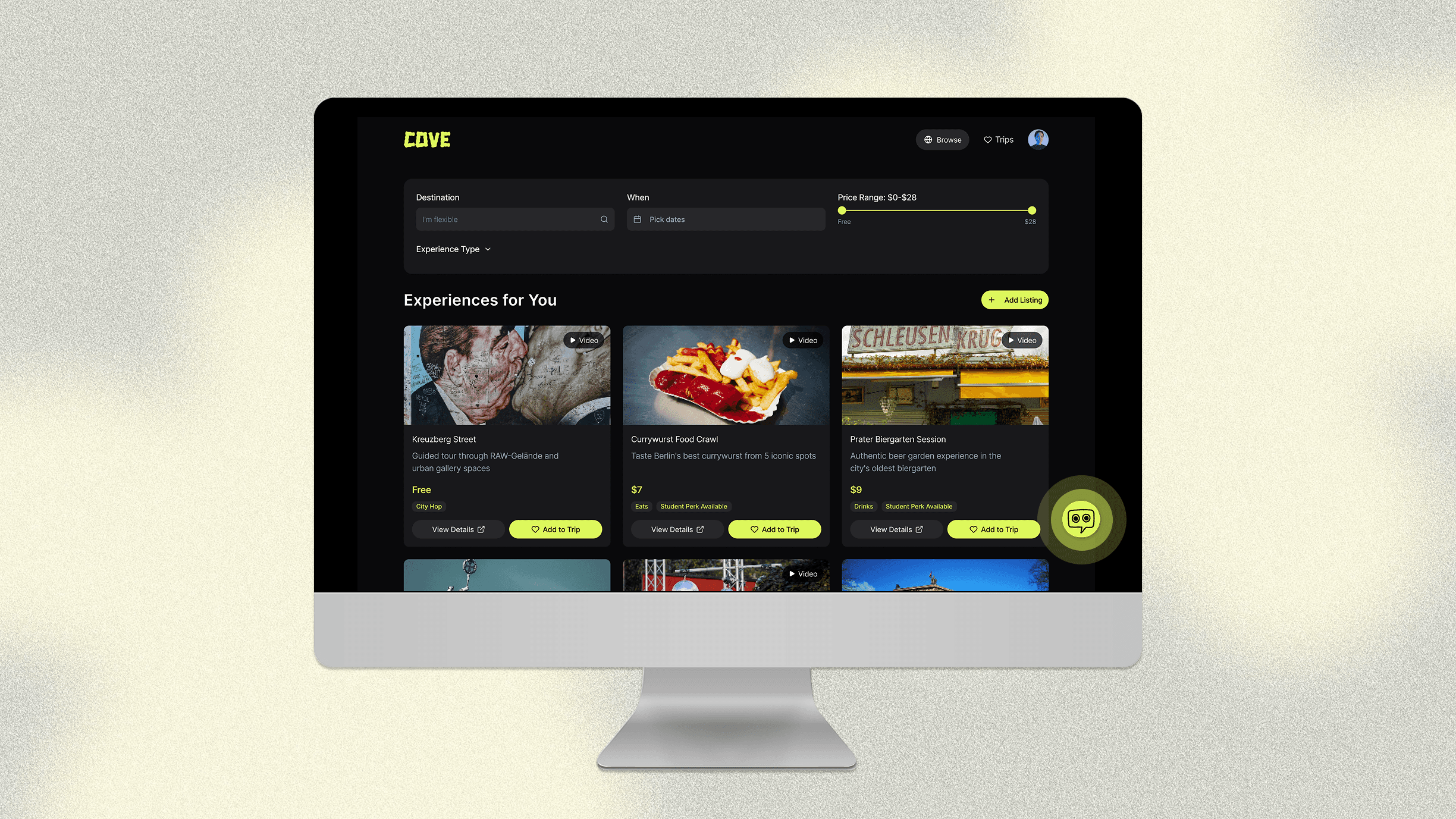
COVE
An AI voice-assisted-travel planner helping students discover attractions and hidden gems around the world.
Type
Time
24 hours (Revised)
Team
1 Designer (me)
3 Developers
Role
Project Manager, Research,
Wireframing, Prototyping & UI Design
At New Hacks, a 24-hour hackathon hosted by the University of Toronto, I led a team of four as the sole UX/UI designer to ship Cove, an AI voice-assisted-travel planner helping students discover attractions and hidden gems around the world.
I drove the end-to-end design process, from research and ideation to high-fidelity prototyping, delivering an innovative solution that won the Best Use of Eleven Labs Award among 200+ participants!
Preview
Hackathon Challenge
Create an impactful travel, finance, or self-wellness app that integrates AI meaningfully.
Constraints
From the get go, I identified our constraints to inform our product direction.

Considering the limited time for recruitment, we decided to target students as our users to leverage our own experience for user research.

To utilize our developers' strengths in web frameworks, we prioritized desktop use cases and bypassed mobile optimization.
Identifying the Problem Space
To ensure a focused and impactful solution, I facilitated a lightning brainstorming session to identify problem spaces grounded in our own experiences and pain points.
Frictionless Investment
Shopping/e-Commerce
Budget Travel Planning
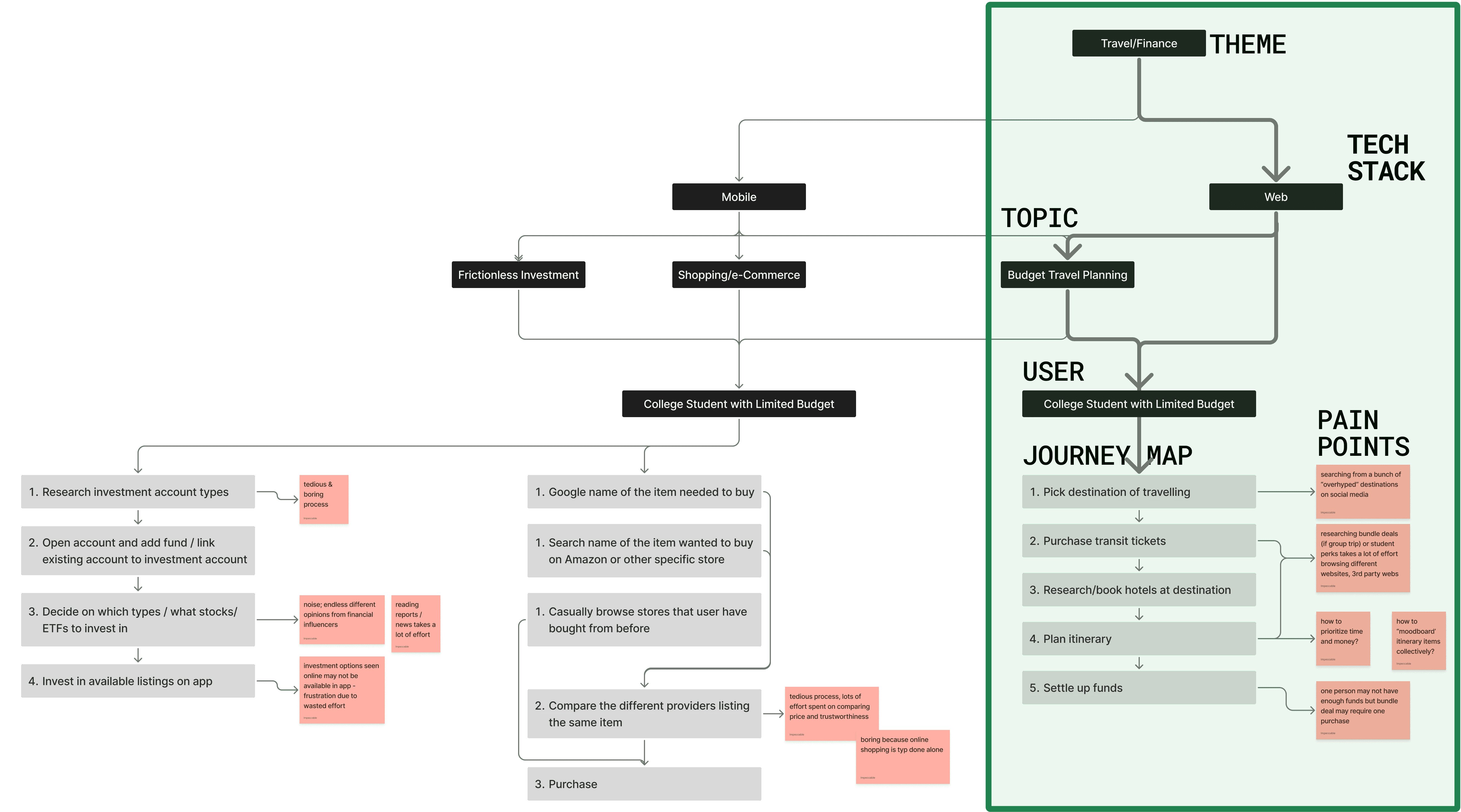
We voted budget travel planning to be our focus as it resonated the most with all members. From our pain points, we synthesized four directions.
Idea Prioritization
After narrowing down on our core pain points, we synthesized three approaches, and evaluated them against three factors:
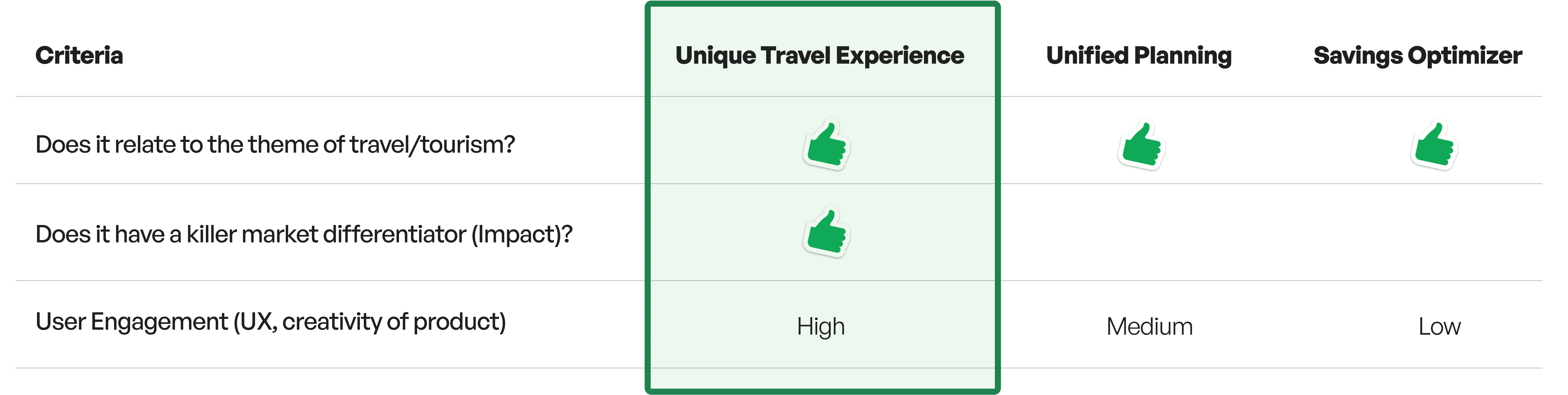
This decision then informed our design challenge ↓
The Challenge
How might we help budget-conscious students discover and plan unique travel experiences?
Secondary Research
Using Perplexity AI, I quickly researched some emerging trends and gaps in the market.
"Mature products like Wanderlog has limited AI or financial integrations."
"Many users report that travel apps — especially booking platforms — are difficult to navigate, with unintuitive interfaces and confusing flows."
"Travel apps sometimes operate more as marketing channels than honest guides, filtering out negative or mixed feedback."
To tackle the difficulty of navigation and concern of ad-filled recommendations, our product aims to create an easy browsing experience with trustful AI-assistance.
User Research
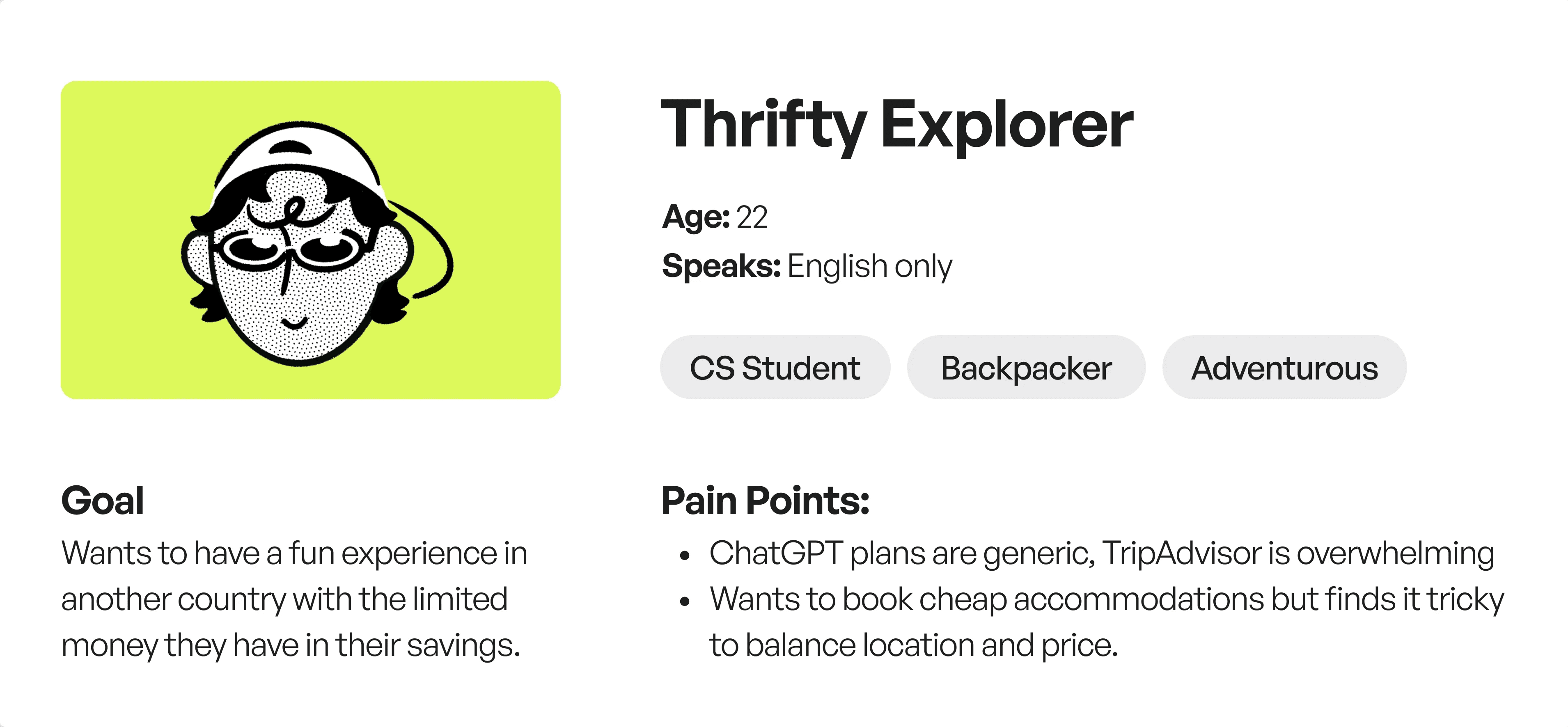
For qualitative user research, we reflected on our own experiences which informed our persona.
Wants to avoid tourist traps overhyped on social media.
Research takes a long time to find fun & budget-friendly things to do.
Wants to use LLMs to his advantage but finds prompting a hassle.
Solution Ideation
We synthesized our insights into core features and prioritized three:
Feature 1
Hidden Gems Search
View/search member-reviewed activities based on location, price, and type.
✓
Avoids tourism traps
Feature 2
AI-Recommendations
Get personal suggestions by talking to an AI assistant, like a real person.
✓
Reduce hassle of research
Feature 3
Saving to Trips
Save activities to separate trip folders with customizable totals (i.e. cost, type, map).
✓
View all activities in 1 place
To ensure a well-focused solution, we asked ourselves:
Question 1
Is this AI-integration really necessary?
The AI voice assistant (powered by ElevenLabs) is designed to reduce decision fatigue via a fully automated, hands-free discovery. At the same time, we balance this with a manual exploration mode, where users earn redeemable perks for contributing trustworthy reviews, creating a self-sustaining ecosystem of verified travel intel.
Question 2
How would this differ from market competitors, like TripAdvisor?
Rather than providing a comprehensive acitivity booking site or itinerary builder, we are designing a minimal task flow solution. We prioritized on a 'loose-planning' framework that allows users to find tailored activities quickly with minimal effort.
Task Flow
I mapped two pathways for discovery: manual browsing and with AI-voice-assist.
These two approaches ensured that we design for both user types who prefer granular control via filters and those seeking an effortless, hands-free planning experience.
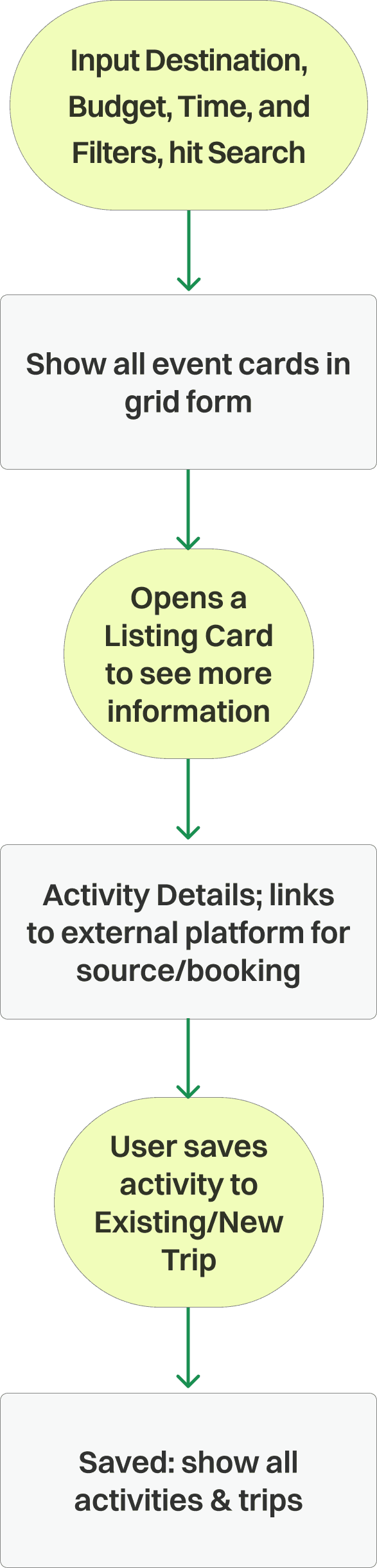
Task Flow: Manual Exploration
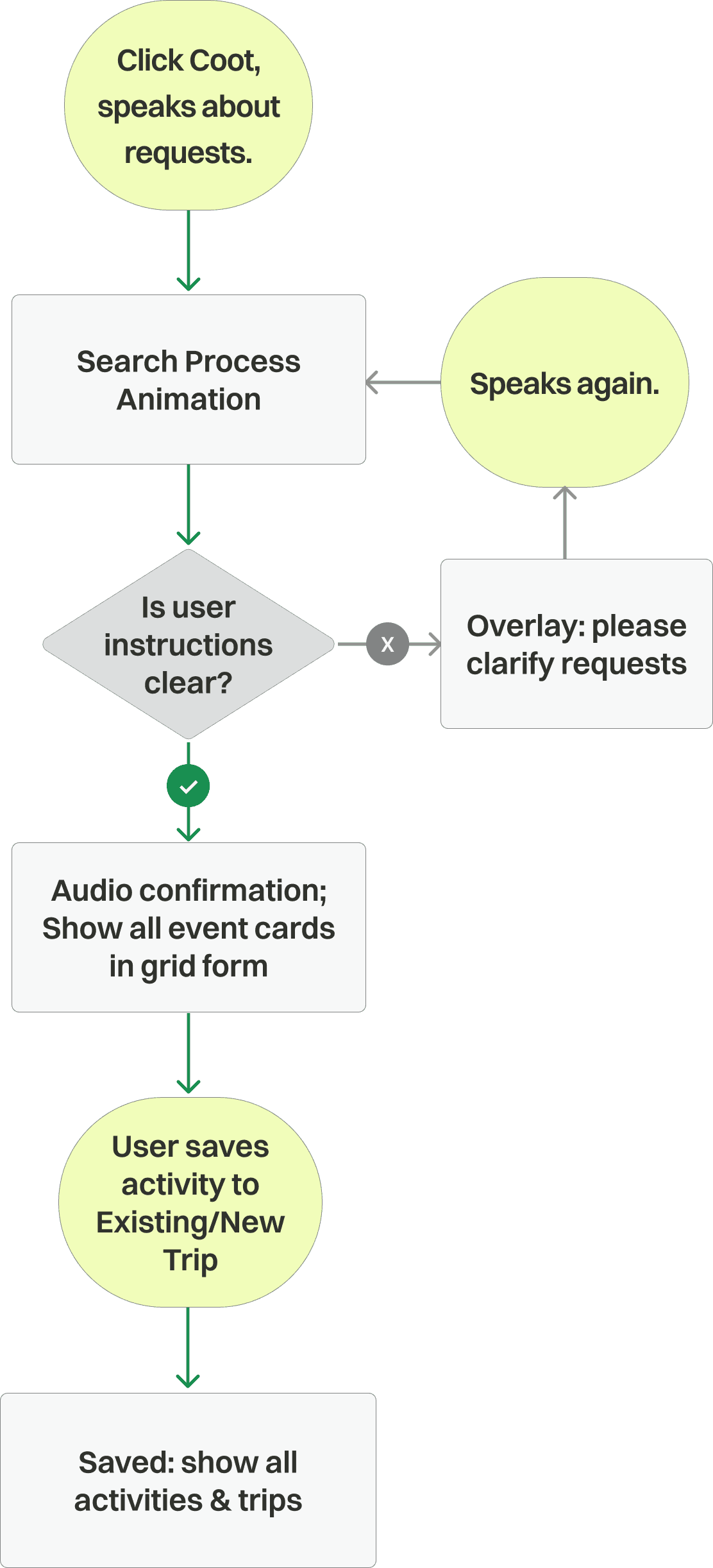
Task Flow: AI-Voice-Assisted Search
Iterated MVP
I used Figma Make to jump start a high-fidelity prototype.
Since we only prioritized on a few core features during the hackathon, I revisited this project to reiterate the key screens to craft a better user experience.
Filtering and browsing for things to do using filters.
Using AI-voice assist.
What's Next for COVE?
Refining the Human-AI Interaction
To counter the 'black box' ambiguity common in Gen-AI, I aim to visualize the system's reasoning as a transparent decision trail. By visualizing how specific user inputs influence the output and how AI uses logic and data to "think", I aim to foster deeper user trust with AI-integration in products.
From desktop to On-The-Go!
Our next step would be to expand the use cases of our application, translating the desktop MVP into a mobile-responsive experience, leveraging real-time geolocation to push "Nearby Activities" notifications to students as they explore a city.
Lessons Learned
Be transparent, overcommunicate, align
Right from the get go, we discussed our skills and preferences, and shared our own experiences which became the basis of our design and roadmap. I …
Prioritize even more ruthlessly
Despite our efforts in narrowing scope, our final solution included three complex features. I learned that establishing a clear, ruthlessly prioritized roadmap that strips down into even less features could grant more refined solutions in a time-sensitive environment.
Designing with everyone
During this hackathon, I primarily used Figma Make to generate high-fidelity prototypes only after sketching out low-fidelity wireframes. In retrospect, I learned that onboarding the entire team to gen-AI tools earlier would have allowed us to leverage our collective creativity for quicker iterations.